01
Category Structure Audit
Understand your category from your customer's POV.
Anchored by a proprietary methodology for uncovering the non-obvious structure of your category to surface high-leverage, structural opportunities and white space.
PROBLEM THIS PROGRAM SOLVES
Companies make positioning decisions without a customer-centric category map.
Every company has a theory about how their category works. Where they sit. Who they compete with. What their customers value.
But customers see the world differently than company leaders. And the real way they organize your category will almost surely surprise you.
The Category Structure Audit helps companies stop making positioning decisions based on how they think their category works and delivers a precise map with structural opportunities to get an unfair advantage.
DELIVERABLES
What a Category Structure Audit produces.
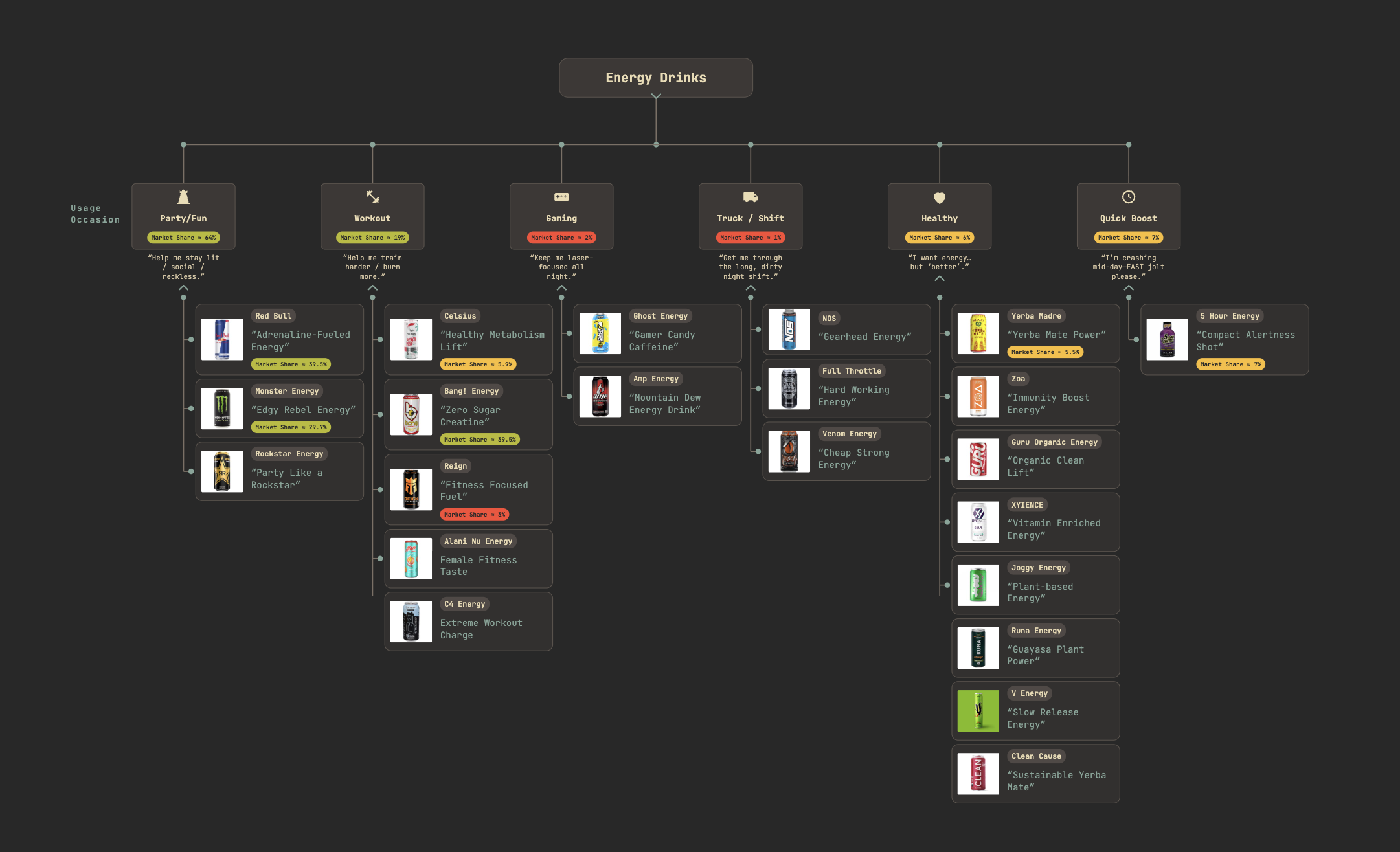
This is diagnostic strategy. You get the cognitive map of your competitive landscape, a clear picture of where you stand, and a strategic recommendation on structural category opportunities the model surfaces.
- 01
Cognitive Position Map
Where buyers are actually filing you, based on synthetic consumer data from your specific market. What category words they reach for. What companies they compare you to. What problem they assume you solve. A taxonomic map your leadership team has never seen.
- 02
Prototype Gap Analysis
Who owns the prototype position in your category (and subcategory), what attributes define it, and exactly where you sit relative to it. This reveals whether you're challenging on their terms (hardest fight), operating below them (pricing trap), or positioned orthogonally (where micro-monopolies get built).
- 03
White Space Map
A visual competitive landscape showing where cluster zones create commoditization pressure and where unclaimed positions exist. The territory between existing prototypes that nobody has planted a flag in yet.
- 04
Strategic Brief
The clear recommendation: what cognitive territory to claim, what language to use, and the sequenced actions to start converting the claim into reality. Precise enough to guide every downstream decision for the next 18 months.
THE PROCESS
Five weeks. Four phases.
- 01
Configure
Lock the battlefield. Define which brands, competitors, and adjacent players belong in the study. Align with leadership on the exact competitive set so the digital twin maps the right territory.
- 02
Validate
Run the research pipeline via synthetic agent panel. Administer the survey instrument for category structure. Aggregate the data. Produce the structural foundation of the digital twin.
- 03
Analyze
Translate the digital twin baseline into company-specific strategic intelligence. Distill 3–5 actionable opportunities to capitalize on across the portfolio.
- 04
Activate
Present digital twin and structural opportunities to leadership. Walk through the digital twin live. Discussion and next-step recommendations ensue.
WHY THIS WORKS
Category Structure Audits are designed to surface the questions you never thought to ask.
Most positioning work starts with internal interviews and competitor benchmarking. That approach maps how you see the market, filtered through your own assumptions.
That matters because buyers don't evaluate you on a feature-comparison spreadsheet. They slot you into a mental category and compare you to whatever sits at the center of it. If you don't know what that category is, who the prototype is, and where the edges are, you're building strategy on assumptions.
A Category Structure Audit maps the cognitive architecture from the buyer's brain outward. It's grounded in Eleanor Rosch's prototype theory of categorization, the same cognitive science that explains how humans organize knowledge into categories with prototypes at the center and fuzzy boundaries at the edges.
FREQUENTLY ASKED QUESTIONS
How is this different from market research?
Market research measures what you already think to ask. It validates hypotheses. A Category Structure Audit surfaces the structure you didn't know existed. The questions you couldn't have written because they require seeing the market from outside your own assumptions.
We already know our market.
You know your market from the inside. This shows you your market from the buyer's brain. Those are different things. The gap between them is where the strategic opportunity lives.
What do I do with the output?
Most clients use the audit to make one of three decisions: reposition an existing product, identify an innovation opportunity, or restructure a portfolio. The audit gives you the map. We can help with the navigation, but the map alone changes how you make decisions.
Who takes surveys?
Nobody. We use AI-generated synthetic respondents calibrated across expertise tiers. Faster, cheaper, and eliminates the response bias that makes traditional surveys unreliable.
Who is this for?
Founders and executives at strategic inflection points. New market entry, category disruption, rebranding, a funding event that changes the competitive landscape, or a product expansion that requires a new position. If you're unsure what category you're trying to win, this is the starting point.
What if the findings require a hard pivot?
That happens. This is diagnostic work. The answer sometimes reveals that the position you've committed to is structurally wrong. Better to know in 2 weeks than to spend two years optimizing the wrong territory.
INVESTMENT
Starting at $12,500.
No retainer. No hourly billing. One engagement, one price, one deliverable that changes how you see your market.